Thursday, April 28, 2022

What We're Thinking: SECURE Acts


In 2019, the SECURE Act was signed into law by President Trump. SECURE is an acronym for Setting Every Community Up for Retirement Enhancement Act of 2019.

On March 29th, 2022, the House of Representatives passed Secure Act 2.0. Its full name is Securing a Strong Retirement Act. The Senate version remains in Committee. Regardless, the legislation has broad bipartisan support and will likely become law in 2022.

The combined legislation contains hundreds of provisions. This note is intended to highlight changes that might apply to you. Here’s a synopsis:  

👉 Pre-SECURE Act rules are grandfathered for decedents who passed away before January 1, 2020.

👉The beginning age for required minimum distributions (RMDs) was moved from 70½ to 72 in 2021. 

👉Most non-spousal beneficiaries (like your children, for example) who inherit an IRA must empty the account within 10 years. This has quickly become known as “the 10-year rule.” It eliminates the “stretch IRA” that allowed beneficiaries to potentially extend benefits for decades. 

👉The 10-year rule refers to the 10th year after death. The year of death is Year 0.

👉The rules for surviving spouses of retirement plans and IRAs remain unchanged. The 10-year rule does not apply to spouses. 

👉Inherited IRAs that were “paying out” prior to the SECURE Act are allowed to continue as they were. The 10-year rule does not apply.

👉The age of majority to determine beneficiary designations is 21, even though the age of majority in most states is 18. In the Secure Act, beneficiaries under age 21 are minors.

👉Starting in 2023, all catch-up contributions to employer-sponsored plans must be made to Roth accounts. That means they won’t count as pre-tax contributions, but they'll be tax-free upon withdrawal.

👉Beginning in 2024, the “catch-up provision” for participants aged 62-64 in 401(k) and 403(b) plans will increase to $10,000 annually and be indexed to inflation thereafter. The current provision is $6,500 for all ages.

👉The beginning RMD age will become 73 in 2023, 74 in 2030, and 75 in 2033.

As with most legislation, many details still need clarification. The clarifications are mainly administrative and will come from the IRS. Account custodians such as Vanguard, Fidelity, Schwab, and so on will keep clients informed of any changes.

Here’s the one thing you should do right now:

Review your retirement plans and IRAs to assure that the beneficiary designations are up to date. That includes any Roth, SEP-IRAs, or annuities you might have. Complications often arise where there's been a divorce, death, or other life event, and beneficiaries were never updated.

Feel free to contact us if you have any questions about your situation.

James Cosgrove, CFP, Plano, TX jim.cosgrove@verizon.net 972-489-0262
Jim Cosgrove, Partner, San Jose, CA jimcos42@gmail.com 408-674-6315 Twitter@JimCos542 

Evidence-based. Rules-driven. Policy-focused.


Disclaimer: This post is essentially a matter of tax law and tax planning. It is provided for your information only, and does not constitute tax advice. You are advised to consult with qualified tax professionals, or, if you self-prepare, do your own due diligence.

Thursday, April 7, 2022

What We're Thinking: The Path to the Financial Sweet Spot

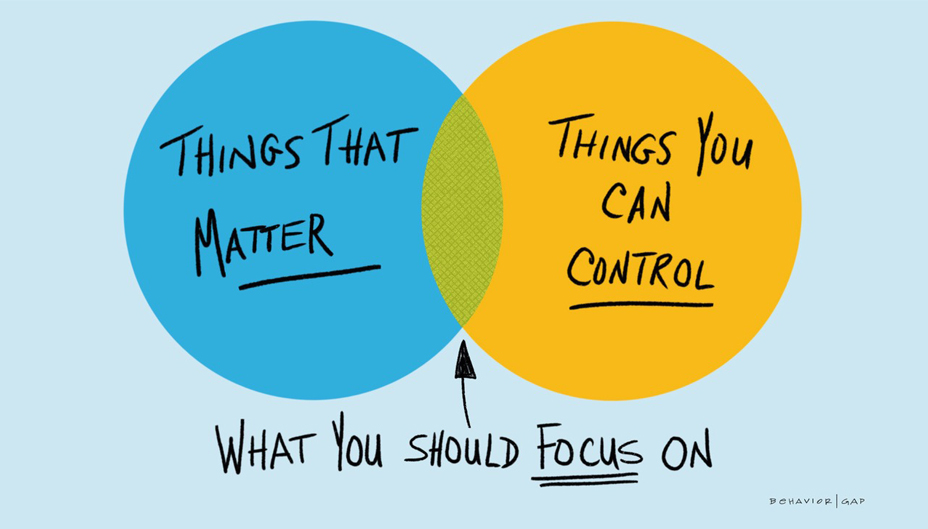
Venn diagram showing intersection of what matters and what you can control is what to focus on.

Earlier this week, I commented to Jane that stocks have never lost money in any period longer than 13 years.(1) Her response was, “But today they’re down.” That was news to me. I hadn’t even checked. I don’t pay close attention to daily price changes. Anyway, we’re not selling today. It doesn't matter.

This triggered more thinking about what matters and what we can control. (Hat tip: Carl Richards, Behavior Gap)

What matters is deciding on what goals to move toward, or of sustaining a particular lifestyle, like say, retirement. Some of that involves financial planning. Surprisingly, much of it doesn't. But all of it is in our control.

What may seem to matter, but over which we have no control is what we hear and see on the daily news noise. Inflation. Ukraine. Interest rates. Pandemic. Oil. The Fed balance sheet. So, do yourself a favor. Limit news consumption.

The "sweet spot" is to find where what matters overlaps with what you can control. Here's the path to the financial sweet spot. 

👉 You have well-honed habits of spending awareness. You're clear about what matters and what's worth paying for. I call it the "price/value proposition." 

👉 You give saving a high priority. We often call it "paying yourself first." If you've already retired reached optionality, you can enjoy not having to save anymore.

👉 You know you are not smarter than the financial markets. So you invest using a low-cost, globally diverse strategy. 

👉 You wisely manage your money emotions. That means managing fear and greed. I like to say that "the hardest thing to do is the rightest thing to do." 

What's the payoff?

Look. Anyone who has done these things over the past 10, 20, 30 years has far outrun the inflation that's in the news. It's called "living off the fat of the land."

In the meantime, when you hear, see, or read something alarming or troubling in finance or economics, just ask yourself, "Does it matter? Can I control it?"

As financial planners, these are the conversations we look forward to having. Here's how to contact us.

James Cosgrove, CFP, Plano, TX jim.cosgrove@verizon.net 972-489-0262
Jim Cosgrove, Partner, San Jose, CA jimcos42@gmail.com 408-674-6315 Twitter@JimCos542 

Evidence-based. Rules-driven. Policy-focused.


(1) https://mobile.twitter.com/wintonARK/status/1509197050918977539


Sunday, February 20, 2022

What We're Thinking: Six Ways to Unlock Home Equity


There’s about $25 trillion of home equity in the United States. That’s nearly half the value of the US stock market. But as you know, home equity isn’t nearly as liquid (accessible) as the stocks or mutual funds you hold. In general, that’s actually a good thing.

So, how can property owners tap into their accumulated equity? Oh, let me count the ways! Here are six, listed alphabetically:

· Cash Out Refinance
· Equity Share
· Home Equity Line of Credit (HELOC)
· Home Equity Loan
· Reverse Mortgage
· Sell


A brief description of each is below, with Pros and Cons.

But wait! There are disclaimers. They are usually tucked away at the end of messages, in fine print that no one reads. In this case, we’re putting them right up front.

None of the following constitutes property management advice or is an offer or recommendation to buy or sell any product or service. The descriptions below are offered in good faith, but are not guaranteed to be accurate, complete or exhaustive. Doing so would make this TL;DR (too long didn’t read). Household needs, circumstances, and solutions vary widely. Consult with reputable and trusted tax, legal, and financial advisors before proceeding.


👉 Cash Out Refinance
This is where an existing mortgage is replaced with a new, larger one that has a lower interest rate. The property owner pockets the difference between the old mortgage balance and the new one, less the transactional fees.

Begin the process by contacting your current lender to see what’s on offer. Use a mortgage refi calculator like this to get some rough estimates. These will give you a stake in the ground to make competitive comparisons. Then maybe shop at a place like Lending Tree.

Pros
There are no restrictions on how you use the money.
There are no tax consequences.
It can get you over a short-term cash demand like for higher education or doing a major home improvement.

Cons
You’ll need to show that you’ll be able to make the new payment. A good FICO score helps.
Interest rates on cash-outs are higher than for standard financing.
It’s likely you’ll end up paying more interest over the total life of the mortgage.
There are closing costs and fees. “No fees” usually result in higher payments.
A cash out refi reduces the equity you’ll realize when the property is eventually sold.


👉 Equity Share
Equity Sharing has become increasingly popular. This is where the homeowner gets cash in exchange for future equity gains. A $1,000,000 property might give you up to $800,000 of cash without selling. However, when the ultimate resale happens, the owner will get none of the increased value from the time the Equity Share was created.

Pros
Property owner gets cash.
Proceeds can be used for any purpose.
Property owner does not have to sell or move.
There are no tax consequences.

Cons
The homeowner surrenders all future equity accumulation.
Fees can be substantial.
 

👉 Home Equity Line of Credit (HELOC)
A Home Equity Line of Credit is similar to a Cash Out Refinance, except the original mortgage is not replaced and a new one is created. In essence, it’s a second mortgage with a second set of mortgage payments. Owners usually set up a “credit line” and access it as needed.

Pros
The property owner has flexibility about when to access funds and by how much.
There are no restrictions on how the money is used.
The property owner does not have to sell or move.
There are no tax consequences.

Cons
Interest rates are usually higher than a cash out refi.
A second payment is created.
Adds to a property owner's fixed costs.

 
👉 Home Equity Loan
A Home Equity Loan is when a large lump sum is borrowed against the equity built up in a property. Lenders might allow borrowing up to 80% of the property equity if the borrower is in excellent financial condition. The loans usually have fixed interest rates and repayment periods are typically 5 to 30 years.

Pros
Property owner gets a lump sum.
There are no restrictions on how the money is used.
Property owner does not have to sell or move.
There are no tax consequences.

Cons
If there is one mortgage still active, this is essentially a second mortgage.
Defaulting on payments can lead to foreclosure.
Owner equity is diminished.
Fees can be substantial. 


👉 Reverse Mortgage
A Reverse Mortgage uses the property equity to pay cash back to the property owner. Government rules do not require the homeowner to pay back the amount before any specific period. Nevertheless, you’re giving back a stake in your property to the lender in return for cash flow. Heirs to the property will need to pay the loan back if they want to keep it.

Pros
Produces a monthly income to the property owner.
The 2022 reverse mortgage maximum is $970,800.

Cons
Property owner must be at least age 62.
Property owner’s equity is reduced.
Heirs must pay back the proceeds if they keep the home. 

See also: https://www.wsj.com/podcasts/your-money-matters/reverse-mortgages-have-they-beaten-their-bad-rep/1dbb549a-4ab7-4022-b26b-77a483f96742


👉 Sell
The most straight-forward of all the equity liberation options.

Pros
You have cash in your pocket. No strings attached.
You can easily rightsize or relocate.

Cons
You still need a place to live.
Transaction costs.
There may be capital gains taxes.
 

Added this on 4/7/22: https://www.advisorperspectives.com/articles/2022/03/21/how-to-safely-cash-in-on-your-home-equity-windfall


James Cosgrove, CFP, Plano, TX jim.cosgrove@verizon.net 972-489-0262
Jim Cosgrove, Partner, San Jose, CA jimcos42@gmail.com 408-674-6315 Twitter@JimCos542 

Evidence-based. Rules-driven. Policy-focused.