Tuesday, June 16, 2026

What We're Thinking: Your Personal Finance Game Plan for 2026-2028


From now until the 2028 election, we’ll be told with great confidence about what the economy will do, what Washington will do, what markets will do, how much of an impact AI will make, and what you must do about it.

This is mostly theater because markets, economics, and politics are multi-variate, non-linear systems. That's fancy language for something that has a lot of seemingly unrelated moving parts, where small changes can produce huge reactions in unexpected places, and where very little is predictable. This is not new. We just hear about it sooner than we ever have.

There are two elections, a new Federal Reserve board chairman, and adjustments in Middle East geopolitics that will challenge the most carefully crafted strategies. Looking back on New Years Eve 2019, no one had COVID (literally), the 2022 inflation, the 2025 Tariff Tantrum, or a military action in 2026 on their screens. Statistically speaking, someone will call what comes next. And statistically speaking, the odds of finding that someone round to zero. Risk is what’s left after we’ve thought of everything else.

So, what hasn't changed? And what can you control?

✅The importance of asset allocation and diversification. A portfolio spread across multiple asset classes, geographies, and company sizes does that work. Underperformers will recede in value while the things that are working grow larger. That’s why, if you’ve owned a large company investment fund, you’ve actually owned some Nvidia since 2001, when it replaced Enron in major market indexes. No guessing or research was needed. You control this. You decide what, where, and how to allocate and diversify. We can help with that.

Having a clearly articulated strategy. Complexity and over-thinking invites tinkering. Tinkering often leads to unforced errors and self-inflicted damage. If you’re not clear about what your strategy is, we need to talk. 

✅The quality of media. Headlines are optimized for emotion and urgency. “If it bleeds it reads.” “News” is actually opinion, no matter which political color you identify with. Don’t conflate politics with your portfolio. 

✅The urge to “do something.” We all get that from time to time, especially when emotions are running hot. If a strong opinion calls to you, create a financial sandbox. Put money in it that won’t change your life if you lost it. That will minimize any damage and manage your FOMO.

✅Long-run stock returns closely reflect corporate profits. As we’ve shown in prior Considerations, that’s been the case for over a 100 years. That said, U.S. large growth company valuations—the premium that investors are willing to pay for those earnings—are historically rich. That takes us back to asset allocation and diversification, which rewards patience more than activity.

“Unprecedented” events will continually pop up. But no matter what unfolds, these five pillars will help you stay the course according to your goals, time horizon, and tolerance for discomfort. We’re here to travel this journey with you. 


 James Cosgrove, CFP, Plano, TX jim.cosgrove@verizon.net 972-489-0262
Jim Cosgrove, Partner, San Jose, CA jimcos42@gmail.com 408-674-6315

Evidence-based. Rules-driven. Policy-focused.


Sunday, March 29, 2026

What We're Thinking: Another 25 Years


Back in the Spring of 1991, I joined IBM's Quarter Century Club, marking 25 service years. Now, in the Spring of 2026, I'm celebrating another Quarter Century milestone, this time as an independent, freelance financial advisor. Two quarter centuries in one lifetime. Who knew? 

Doing what I'm drawn to do, I've pulled together some financial stats from the last 25 years. Here's what's happened on an average annualized basis: 

Inflation/CPI                                                 2.5%
All fixed income (cash, CDs, bonds)           3.5%
Portfolios of 40% stocks and 60% bonds    4.1%
Bay Area residential real estate                   4.7%
Portfolios of 50% stocks and 50% bonds    5.2%
Portfolios of 60% stocks and 40% bonds    6.3%
Portfolios of 80% stocks and 40% bonds    8.4%
 
The great news is that everything has stayed well ahead of inflation. Not only has wealth been preserved, it's been enhanced. This is not a forecast, a prediction, or investment advice.

Now, zooming in to the Main Event.  

We're a bit more than halfway through this decade and there have been four "disruptions" no one predicted. COVID in 2020-21, 9% inflation in 2022, a Tariff Tantrum in 2025, and now a "military operation" in Iran.

Keep this in mind the next time you hear an "expert" or "influencer" tell you what's about to happen and what you must do now! Predictions are useful for eliminating things to worry about. It's been said that "risk is what's left after you've thought of everything else." Which leads to the next point: It's impossible to worry about unknown unknowns.

The table below highlights market data points we follow as of March 27, 2026. Notice that none of them are personal or political. We don't conflate personalities or politics with personal finance. That dog don't hunt.


Mar 2020

Oct 2022
Apr 2025
Mar 2026
Notes

COVID

Inflation
Tariffs
Iran


Money market funds 0.10%

4.00%
4.20%
3.60%
1
US Treasury 10-year bond yield 0.80%

4.00%
4.00%
4.30%
2


Brent North Sea oil $32

$83
$92
$114
3


CNN Fear & Greed Index 2

16
4
10
4
Peak VIX   85

36
60
35
5


Balanced portfolios prev 12 months-23%

-29%
-20%
-8%
6
Balanced portfolios next 12 months+42%

+18%
+26%      ?

Notes:

1. Most banks are still paying .1%. The difference between that and 3.6% is how we're able to get free checking accounts. 

2. This is the key indicator for fixed income. The rate has fluctuated between 3.3% and 5.0% since 2022. As long as it stays under 5%, all's well. Not a prediction or investment advice.

3. Few paid much attention to oil until lately. Suddenly, everyone's an oil expert. What's most useful to know is that oil above $90 puts pressure on global finances, discourages drillers, and punishes consumers. There are incentives all over to get this mess cleaned up.

4. The CNN Fear & Greed Index is a reliable short-term measure of financial market sentiment. Anything under 25 is Extreme Fear. As Warren Buffet has said, "Buy when people are fearful." Not investment advice.

5. VIX is the Chicago Options Exchange Volatility Index. It's another measure of sentiment widely used by professionals. Readings above 30 have been harbingers of better times.

6. Balanced portfolios are found as funds and ETFs at Vanguard, Fidelity, Schwab, and your own favorite broker. Most investor's portfolios are pretty close to these. Check with us to talk about what you have.

So, that's where we are. A long time ago, I heard someone say, "Things are never as bad as they seem, or as good as they seem." If you'd like to chat about any of this, or even tell us how we're getting it all wrong, we'd love to hear it.

 James Cosgrove, CFP, Plano, TX jim.cosgrove@verizon.net 972-489-0262
Jim Cosgrove, Partner, San Jose, CA jimcos42@gmail.com 408-674-6315

Evidence-based. Rules-driven. Policy-focused.


Tuesday, March 3, 2026

What We're Thinking: What Happens in Markets During Wars?

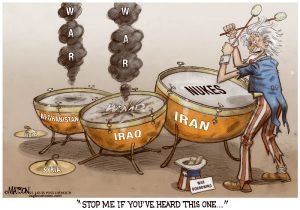
 war drums

They're at it again. When will we ever learn?

In the meantime, financial markets are in the news and you might be wondering how to navigate this particular case. We take a broader, long-term view of historical precedents. Here's what we see.

There are eleven war cases, going back to Pearl Harbor. One year later, the S&P 500 was higher in eight of the eleven cases. That's a 72% positive rate. And it's only for one year. Longer time frames produce outcomes exceeding 90%. 


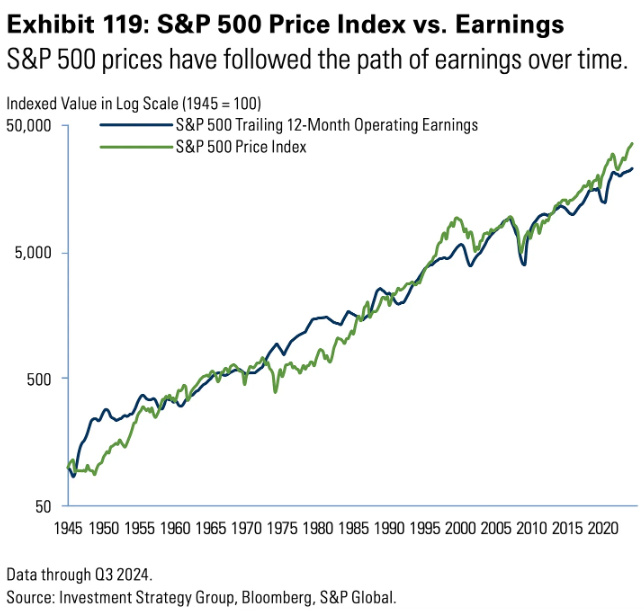
The main long-term driver of stock market returns is not war or peace. It's corporate earnings (profits). Except in recessions, profits continuously move higher. Here's an 80-year illustration. Earnings are in black. The S&P 500 is green. 

As usual though, there's a caveat. In this case it's valuation.

Valuation is an expression of the premium above fair value that buyers are willing to pay. At this point, buyers are paying a historically high premium for U.S. stocks. (International stocks are closer to fair value.)


This doesn't necessarily mean there has to be a crash. It does mean we should expect lower average annual returns going forward. Some analysts are calling for low single-digit average annual returns for the next 10 years. We actually use those conservative values in estimating low ranges of future portfolio values. 

If any of this concerns you or you just want to talk about it, we're here. We can have the conversation that uniquely applies to you.


James Cosgrove, CFP, Plano, TX jim.cosgrove@verizon.net 972-489-0262
Jim Cosgrove, Partner, San Jose, CA jimcos42@gmail.com 408-674-6315

Evidence-based. Rules-driven. Policy-focused.


Monday, December 8, 2025

What We're Thinking: Your Best Strategy

 Carl Richards (@behaviorgap) • Instagram photos and videos 

“What does 2026 hold?”
“Will the stock market crash?”
“What will happen with interest rates and inflation?”
“Should I buy gold or Bitcoin, or both?”
"Is AI in a bubble?"
“What are the big questions facing the markets in 2026?”
“How should we deal with what’s going on in Washington?”
“Will Social Security go away?”

Sorry. We don’t have answers to those questions. Why? Because some version of them show up every year as a response to a demand and hunger for certainty. Yet, the documented research on forecast reliability concludes that it's pretty much a coin toss. The truth is, the world is uncertain, and personal finance is largely an exercise in managing uncertainty.  

With that out of the way, let's remember what we control. We can't control or accurately answer any of the questions above. But we can control things like...

· How we allocate financial assets. This shapes over 90% of portfolio outcomes.
· How much media we consume and what kind. This blog post is a rare slice of unconflicted media.
· Where we spend money, especially on discretionary choices.
· How much money we spend. Many people can actually spend more than they think.
· Our strategies.

Your Best Strategy

“The best long-term strategy is to stick with your long-term strategy."
Elisbetta Basilico

Your best strategy is the one you have. If you’ve been working with us for a while, you know that everything is based on your goals, your tolerance for volatility, your tax profile, and the feel of your day-to-day life. 
 
So, the answers to the questions that typically come up about next year or "the future" are already embedded in your strategy. That’s the best place to work. Here are a few ways to sustain a robust strategy.

1. Keep it simple! A simple strategy is one you could explain to a 10-year old in less than 25 words. Complexity leads to distractions, loss of focus, blurred vision, and conflicted actions.

2. Be adaptable. The world can change quickly. A flexible strategy will allow you to bend but not break, adapt to challenges, and spot new opportunities. The good news is that globally diversified portfolios do this. They automatically catch the cream rising to the top. If you own a total stock market index fund, you’ve actually owned Nvidia for 25 years.

3. Speculate at the edges. If an exciting idea or possibility calls to you, try it out in a small way. Failures won’t be fatal and you can always go deeper. This could also satisfy the need to “do something” or neutralize FOMO.

4. Stay focused. Distractions abound. Know the job-to-be-done, the problem to be solved, the goal to be achieved. Dial down notifications and breaking news.

5. Be action-oriented. Great strategies lay out a clear path and steps to take. Otherwise, a plan just sits on a shelf. This doesn’t mean to always be doing something. It does mean that when something needs to get done, it gets done. Let us know how we can help.

                                                                      Best Wishes for a Joyful Holiday Season
                                                                        And Contentment in the New Year 

 James Cosgrove, CFP, Plano, TX jim.cosgrove@verizon.net 972-489-0262
Jim Cosgrove, Partner, San Jose, CA jimcos42@gmail.com 408-674-6315

Evidence-based. Rules-driven. Policy-focused.


Monday, October 13, 2025

What We're Thinking: Are Stocks in a Bubble?

  Cover image for stock market bubble guide

 Last week’s stock market thunder has added new urgency to the conversation about the possibility of a developing stock bubble.

While that might get clicks and shares on social media, the tailwinds driving this bull market remain in place. The Fed is guiding interest rates lower. Global central banks are doing the same. Company profits remain largely on track. Credit spreads (the difference in yield between high and low quality bonds) are narrow. Even deficit spending counts as a tailwind.

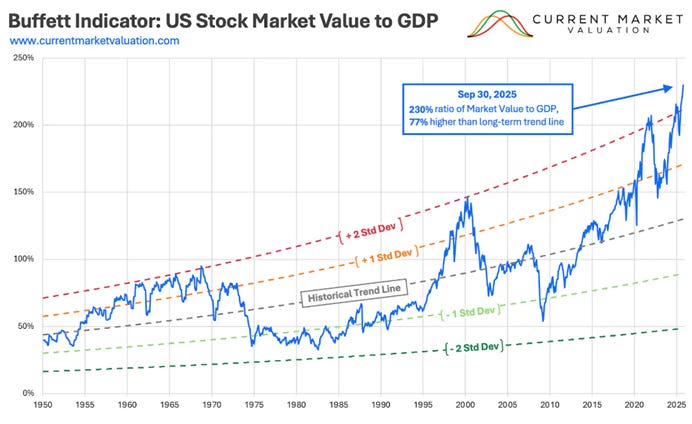
However, while these arguments support continued price appreciation, they can also contribute to a melt-up scenario in which valuations are already historically and statistically over-extended. Almost every major asset class is hitting all-time highs at prices reflecting heavy premiums. Hence, some thoughtful caution is warranted.

First, accurately timing a market peak is 100% luck. Read that sentence again. One especially amusing example was that three days before the 1973 U.S. peak, Time magazine ran an article highlighting the beginning of a gilded age! A new market high did not happen for nine years.

Seven epic bubbles have unfolded over the past 100 years. The U.S. in 1929, 1973, 2000, and 2007. Japan in 1989. China in 2007 and 2015. All of them show that time and hindsight were needed to identify a peak. No one knows they’re happening in real time.

So, what’s an investor to do? Three things will keep you sane:

  1. Mind your asset allocation policy. Stay in your lane. 
  2. Make changes incrementally over time. Avoid sudden “all-in” or “all-out” bets.
  3. Build ready cash or short-term bond resources. Liquidity is your edge in a downturn.

Age group and generational demographics help shape strategy. There are Youngs, Middles, and Olds.

👉Youngs are under age 40. They are building personal capital through career development and financial capital through saving and investing. In hindsight, every market downturn, without exception, has been a golden opportunity to buy quality assets “on sale.” Their job is to hold their noses and continue to invest aggressively in all market conditions. Full stop.

👉Middles are between 40 and 70. This group has reached full development of personal capital. They’ve built a base of financial capital. Sooner or later, they retire. This is the most challenging age group. There’s an inclination to press hard to maximize retirement savings, but in doing so, may expose themselves to significant declines and limited time to ride the eventual recovery. Recoveries after full blown bubble collapses can take several decades.  

Careful planning needs to take place in these years. Contact us if you or someone you know is in this age group and they’re trying to wing it or just hoping for the best.

👉The over 70 Olds tend to already be more conservatively positioned, so market trends have less of an impact on them. However, the news background during declines is always troubling. This causes people to think about doing potentially regretful things like going to all-cash or buying an annuity.

Please contact us if any of this raises questions or concerns for you. We were made for these times.


James Cosgrove, CFP, Plano, TX jim.cosgrove@verizon.net 972-489-0262
Jim Cosgrove, Partner, San Jose, CA jimcos42@gmail.com 408-674-6315

Evidence-based. Rules-driven. Policy-focused.


Sunday, September 21, 2025

What We're Thinking: Making Your Donations Count

Smart giving: how to make your donations count 

Every day, mothers visit food banks seeking to sustain their families. Every day, someone with a substance issue calls for assistance. Every day, a young person realizes they need to build an income-producing skill. Every day, it seems we read that the Trump administration is dialing down support and assistance for vital human services in our communities. 

This is a problem we can address. Community nonprofits take on important social issues and provide essential services in our communities. They include food distribution, shelter, domestic protection, youth programs, health, education, libraries, public safety, and many more. 

Those organizations rely on multiple financial resources to sustain their programs. In addition to individuals like us, there are foundations, endowments, and large philanthropic donors. With changing priorities in governmental support, nonprofits will be relying more than ever on non-governmental sources. That's where we can help.

For those willing to make donations, there still might be uncertainty about where to make them, how much to give, and avoiding scams. We have some ideas for your Consideration.

Are you drawn to helping others and tackling social issues head-on? Then you might want to consider a career in the vibrant world of social services non profit organizations.

In our ever-evolving world, where challenges and disparities persist, social service nonprofits play a vital role in creating a better tomorrow. These organizations, driven by compassion and commitment, provide critical services that contribute to economic stability, mobility, and community well-being.


Read more at Social Work Portal: https://www.socialworkportal.com/social-service-nonprofits-guide/

Are you drawn to helping others and tackling social issues head-on? Then you might want to consider a career in the vibrant world of social services non profit organizations.

In our ever-evolving world, where challenges and disparities persist, social service nonprofits play a vital role in creating a better tomorrow. These organizations, driven by compassion and commitment, provide critical services that contribute to economic stability, mobility, and community well-being.


Read more at Social Work Portal: https://www.socialworkportal.com/social-service-nonprofits-guide/

Where to give. 

We begin with the idea of "thinking globally and acting locally." Yes, the needs of the planet are mind-boggling and beyond the reach of any one person or agency. But the needs in our communities and neighborhoods are often very visible. You know your community and neighborhood's needs better than anyone.

We think meaningful impacts can be made to smaller, local, nonprofits. They might be new or have limited reach because they don't yet receive support from larger entities, or are simply unknown. This is where your donations could make notable difference. Act locally.

How much to give. 

IRS records show a wide range of giving patterns. The average is about 6% of income. Some people use "tithing" (10% of income) as their standard for giving. Whatever you give matters.

If you're 70 1/2 this year and have an IRA, you can make up to $108,000 of donations via a QCD (qualified charitable donation) that will be tax-exempt. If you must take a Required Minimum Distribution (RMD) from an IRA, a QCD will count towards the RMD and not be taxed.

A donor-advised fund (DAF) may be another possibility. An account is established. You make donations as you wish and get an immediate tax benefit. Then you make grants to qualified charities as you wish. DAFs are ideal for those who want flexibility and impact without the burden of running a private foundation. Consult with your tax advisor before opening a DAF.

For more information on how any of these might work for you, please get in touch with us. 

Avoiding scams.

Scams abound, especially when related to sudden dramatic disasters like storms, floods, earthquakes, and fire. There are ways to vet 501(c)3 charities for their efficiency and impact. 

A key document is a charity's IRS Form 990. Each 501(c)3 must file one annually. This takes some effort, but there are reliable resources that compile this information. Here's a list:

  • Candid (formerly GuideStar): Offers a large database with profiles on millions of nonprofits, summarizing their mission, programs, and financial information. Registration is free.
  • Charity Navigator: Provides easily understandable ratings based on financial health, accountability, and transparency using data from the IRS and charities themselves. 
  • Charity Watch: An independent watchdog that provides in-depth analysis of charities' audited financial statements and tax filings, aiming to ensure donations are used effectively. 
  • BBB Wise Giving Alliance: Evaluates charities based on standards related to governance, finances, fundraising, and effectiveness. 
  • GiveWell: Focuses on identifying and recommending charities that are highly cost-effective and impactful, often with a different methodology than other raters. 

Finally, if you need to figure out how to make these things work in your financial plan, we'd love to help. We're enthusiastic proponents of helping individuals make a difference in their communities. 


 James Cosgrove, CFP, Plano, TX jim.cosgrove@verizon.net 972-489-0262
Jim Cosgrove, Partner, San Jose, CA jimcos42@gmail.com 408-674-6315

Evidence-based. Rules-driven. Policy-focused.

Tuesday, July 8, 2025

What We're Thinking: OBBBA

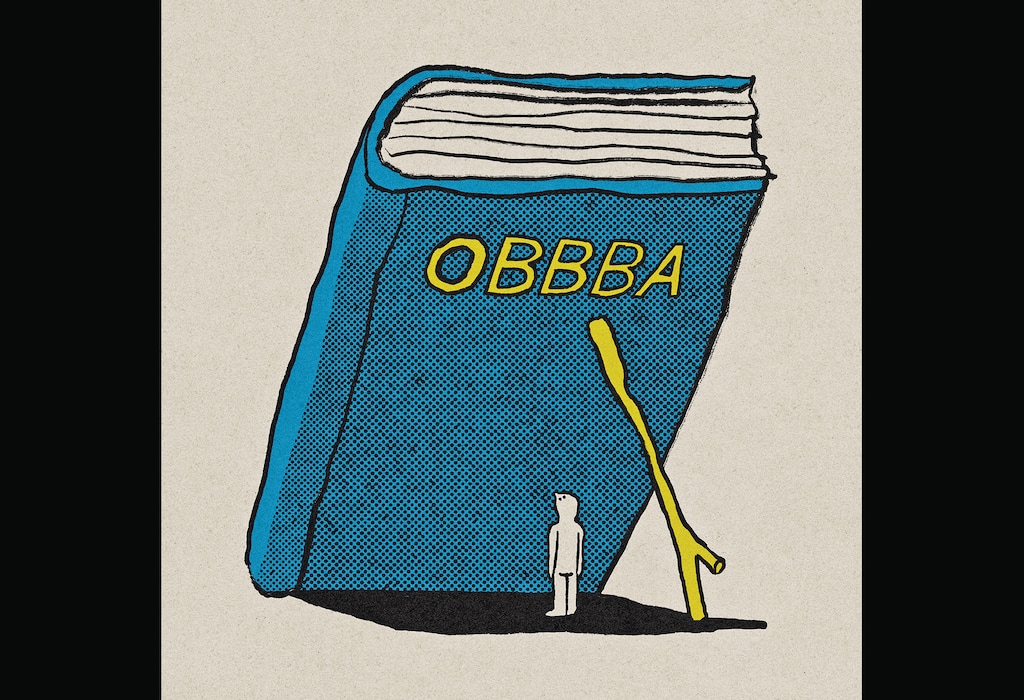
  (Dave Bowers/The New York Times)

One Big Beautiful Bill Act. We'll leave the "Beautiful" part to the politicians. 

This post highlights sixteen items from the Act. We think they could be of interest to folks like us, in the solid, prosperous 9%, just below the top 1%.  

The bill extends many provisions of the 2017 Tax Cuts & Jobs Act (TCJA) and adds new items that reflect the priorities of the current administration. Understand that this is an overview and is not tax or investment advice. Consult with your tax advisor, do your own due diligence, or contact us to discuss your situation. . 

A note about the word "permanent." In tax bill jargon, permanent means there's no end date or "sunset" date for a provision. A permanent provision will last until legislators decide to change it. This is in contrast to items that have end dates. The point here is to know that permanent doesn't mean forever, and it's useful to be aware of possible end dates. 

Let's get into it.

✓ Tax rates: The tax rates enacted in 2017 were made permanent. So, your tax bracket status won't change except for inflation adjustments.

✓ Standard deduction: The increased standard deductions enacted in 2017 were made permanent. The standard deduction is $15,750 for single filers and $31,500 for married individuals filing jointly. The standard deduction will be adjusted for inflation after that. These changes include 2025.

✓ Personal exemptions and senior deduction: The bill permanently sets the deduction for personal exemptions at zero. However, it provides a temporary $6,000 deduction for taxpayers who are age 65 or older. This senior deduction begins to phase out when a taxpayer’s MAGI (modified adjusted gross income) exceeds $75,000 for individual filers or $150,000 in the case of a joint return. It will be in effect only for the years 2025 through 2028. 

This has been politically sold as the "no tax on Social Security" feature. In fact, the bill makes NO changes to how Social Security is taxed. The bill makes no carveouts or direct exemptions. It’s flat out false for anyone to say or insinuate the bill made Social Security not taxable.

✓ SALT cap: The bill temporarily increases the SALT cap (state and local taxes) to $40,000 from the current $10,000. In 2026, the cap will be $40,400, and then will increase by 1% annually, through 2029. Starting in 2030, it will revert to the current $10,000. (Not permanent!)

The $750,000 limit on residential mortgage principal against which interest can be deducted was made permanent.

✓ Itemized deductions limitation: The bill permanently removes the overall limitation on itemized deductions (known as the Pease limitation) and replaces it with a new overall limitation on the tax benefit of itemized deductions. The amount of itemized deductions otherwise allowable would be reduced by 2/37 of the lesser of (1) the amount of the itemized deductions, or (2) the amount of the taxpayer’s taxable income that exceeds the start of the 37% tax rate bracket.

 ✓ Charitable contribution deduction: The bill creates a charitable contribution deduction for taxpayers who do not itemize. Non-itemizers can claim a deduction of up to $1,000 for single filers or $2,000 for married taxpayers filing jointly. For itemizers, the bill imposes a 0.5% floor on the charitable contribution deduction: The amount of an individual’s charitable contributions for a tax year is reduced by 0.5% of the taxpayer’s contribution base for the tax year. 

✓ EV tax credits: The $7,500 electric vehicle tax credit for new EV's will expire on September 20, 2025, regardless of where they were made. Much more detail is available on the Edmund's page here.

✓ Residential solar tax credits: Phaseout of the 30% federal tax credit for installations will lead to its elimination by 2028. 

✓ Residential energy-efficient installations: The Energy Efficient Home Improvement Credit and the Residential Clean Energy Credit will expire for items placed in service after after December 31, 2025. 

✓ Child tax credit: The bill increases the amount of the nonrefundable child tax credit to $2,200 per child beginning in 2025 and indexes the amount for inflation. The bill also makes permanent the $1,400 refundable child tax credit, adjusted for inflation. 

✓ Child and dependent care credit: The bill permanently increases the amount of the child and dependent care tax credit from 35% to 50% of qualifying expenses. The credit rate phases down for taxpayers with adjusted gross income (AGI) over $15,000. It will be reduced by 1 percentage point (but not below 35%) for each $2,000 that the taxpayer’s AGI exceeds $15,000. It will then be further reduced by (but not below 20%) 1 percentage point for each $2,000 ($4,000 for joint returns) that their AGI exceeds $75,000 ($150,000 for joint returns).

✓ Estate and gift tax exemption amounts: The bill permanently increases the estate tax exemption and lifetime gift tax exemption to $15 million for single filers and $30 million for married filing jointly in 2026, and indexes the amount for inflation after that. No one reading this is likely to be impacted by an estate tax.

✓ Moving expense deduction: The bill permanently eliminates the deduction for moving expenses, except for members of the armed forces and certain members of the intelligence community.

✓ Gambling losses: The bill amends the terms of deductible wagering losses to 90% of losses net of gains. 

✓ 529 plans: The bill allows tax-exempt distributions from 529 plans to be used for additional educational expenses in connection with enrollment or attendance at an elementary or secondary school. The bill also allows tax-exempt distributions from 529 savings plans to be used for additional qualified higher education expenses, including “qualified postsecondary credentialing expenses.”

✓ Trump accounts: This is a form of individual retirement account (IRA) under Sec. 408(a) for individuals under age 18. They are not Roth IRAs. Contributions can only be made in calendar years before the beneficiary turns 18. Distributions (withdrawals) can only be made starting in the calendar year the beneficiary turns 18. Accounts will have to be designated as such when they are set up. Contributions are not allowed until July, 2026. 

Eligible investments would generally be mutual funds and indexed ETFs. Contributions will be capped at $5,000 a year and adjusted for inflation after 2027. The bill allows for employer contributions, which will  not be included in the employee’s income.

A new section creates a pilot program that provides a $1,000 tax credit for opening a Trump account for a child born between Jan. 1, 2025, and Dec. 31, 2028. 


Phew! That's a lot. And it's only the "Personal" part. There's another section for "Businesses" but that's not our intent in this space. Let us know of you have any questions unique to your situation.


James Cosgrove, CFP, Plano, TX jim.cosgrove@verizon.net 972-489-0262
Jim Cosgrove, Partner, San Jose, CA jimcos42@gmail.com 408-674-6315

Evidence-based. Rules-driven. Policy-focused.


Saturday, April 19, 2025

What We're Thinking: Silver Linings


Silver Linings 2022

The news, opinions, chaos, and sentiment for a large part of the population is deeply negative. We get it. But this has happened before. Hear us out. 

The University of Michigan Consumer Sentiment Index has been published monthly for over 50 years. It's proven to be a reliable send-ahead on whether to lean into or lean away from investing.

 Michigan Consumer Sentiment

Since 1974, the Index has fallen below 60 in only 4% of all the months, including the most recent reading. That makes this situation quite rare.

In those few extremely negative cases, the stock market- measured by the S&P 500- was higher five and ten years later. Every time. Not only was it higher, but in 71% of the cases, it was higher by more than the well-known 10% average per year. Leaning in paid off. Silver lining.

Next chart. The CNN Fear & Greed Index. 

This Index is a composite of seven stock market indicators. The plots here are monthly through 2024. Since then it has slipped to under 25. Extreme Fear. That's only happened four other times in its history. Each time was an opportunity to lean in. Silver lining.

Next topic. Some factoids about recent markets.

Earlier this month, the S&P 500 was down 12% in four days, one of the largest 4-day declines since 1950. What happened in prior similar cases? Stocks moved substantially higher over the next 1, 3, and 5 years. Every time. Silver lining.

While the S&P 500 was sinking, the Volatility Index (VIX) had its 3rd largest 4-day spike. That put it in the top 1% of its historical readings. Stocks bounced back every time. High volatility = fear = opportunity for long-term investors. Silver lining.

Those were about the downside. What happens when things go up?

Well, on April 9th, the S&P 500 had its largest one-day gain since 1950. What happened in the past following big 1-day gains? Stocks moved substantially higher over the next 1, 3, 5 years. Every time. Silver lining. 

The Dollar
Lots of noise here, too. But when we look at this 40-year record, we're like, meh. Not the end of the world. Not even close. We're about in the middle of the historic range. Lets talk about something else.

The Bond Market
Like the dollar, lots of noise. We use the 10-year Treasury as a basic reference. The rise from near zero rates in 2020 to 5% happened by October, 2023, where this chart begins. Since then, rates have fluctuated between 5% and down to 3.6%. Right now, we're at 4.3%, about right in the middle of the range.

One of three things are most likely from here. Inflation could heat up. Recession could set in. Or there's a combination of the two- stagflation. In the inflation scenario, maybe this goes north of 5. If its recession, we'll be seeing something under 4. Stagflation? Things stay about the same. Stay tuned.


Conclusions
So, what do we do? Historically deep funks like this have happened before. And each time, they've been the nurseries of astonishing rebounds. Every time. We're leaning in. Let's not let a good crisis go to waste.

That said, the short term is typically volatile, messy, not profitable, and stomach-churning, Having sufficient assets outside of the stock market to draw upon as needed is essential. We're also comforted by knowing that anyone reading this already has a globally diversified portfolio with an asset allocation appropriate to their situation and temperament. But maybe you'd still like to talk it over. That's what we're here for. We love those conversations.

James Cosgrove, CFP, Plano, TX jim.cosgrove@verizon.net 972-489-0262
Jim Cosgrove, Partner, San Jose, CA jimcos42@gmail.com 408-674-6315

Evidence-based. Rules-driven. Policy-focused.